Friday, November 18, 2016

MINDFULNESS AND ART THERAPY WORK WONDERS FOR REFUGEES

I truly believe that one can judge the moral decency of a society by looking at how well that society attends to the needs of the sick, the elderly, the marginalised and others in great need of assistance such as refugees and asylum seekers. Many Western nations do not measure up well by that yardstick.

A combination of mindfulness and art therapy is being used to help refugees and asylum seekers in Hong Kong, according to a recent article in The Arts in Psychotherapy.

The article describes how a program which provides workshops on art making and mindfulness meditation has supported individuals in moving forward after traumatic experiences. The authors of the article state that the ‘overlap between art therapy and mindfulness in this context represent the realities of the suffering of the participants as well as the possibility of working towards enhancing coping and resilience.’


Both mindfulness and art therapy have been used with survivors of trauma for some time now. The article published in The Arts in Psychotherapy looks at how a combination of the two can help refugees and asylum seekers acknowledge human suffering and traumatic life events while at the same time recognises the resilience that exists and the search for healing, health and growth.’

The two activities are inherently therapeutic and when used in combination there appears to be a synergistic effect, facilitating the expression of feelings associated with trauma, suffering and the problems associated with coping (for example, anger, rage, vulnerability and depression).


Journal article: Kalmanowitz D and Ho, R T (2016). ‘Out of our mind: Art therapy and mindfulness with refugees, political violence andtrauma.’ The Arts in Psychotherapy49, 57-65. 


RELATED POSTS


IMPORTANT NOTICE: See the Terms of Use and Disclaimer. The information provided on this blog is not a substitute for professional medical advice, diagnosis or treatment. Never delay or disregard seeking professional medical advice from your medical practitioner or other qualified health provider because of something you have read on this blog. In Australia, for immediate advice or support call Lifeline on 13 1 1 14, beyondblue on 1300 22 4636, or Kids Helpline on 1800 55 1800, and for information, advice and referral on mental illness contact the SANE Helpline on 1800 18 SANE (7263) or go online via sane.org. In other countries, call the relevant mental health care emergency hotline or simply dial your emergency assistance telephone number and ask for help.


Friday, November 4, 2016

MINDFULNESS IN THE CHRISTIAN TRADITION (Part 2)

‘But mindfulness is Buddhist!’

I hear those words from time to time from a Christian, usually an evangelical.

Now, as Richard Nixon used to say, let me make this perfectly clear. Mindfulness is not Buddhist. Well, certainly not exclusively or inherently so, and even as respects Buddhism mindfulness is only one aspect of one particular tradition in Buddhism. Mindfulness is universal. It is grounded in the human experience of living fully from one moment to the next.

You can find mindfulness in all religious and spiritual traditions, including Christianity. What’s more, you can find mindfulness outside of religious and spiritual traditions. 

For the most part, the mindfulness that I teach is outside mainstream religious and spiritual traditions, although I do draw from a number of those traditions where I think they are making a valid point, that is, a point of universal importance and one that is generally in the nature of a self-evident truth. Of course, a self-evident truth is not always readily apparent or discernible to people. However, once a self-evident truth is properly understood, you are justified in affirming it as true.

In a previous post I looked at mindfulness in the Christian tradition. In this post, I want to focus on some good advice from the Bible. It’s from the Hebrew Bible (the Old Testament). It is from both the Jewish and Christian traditions, but the advice is good for all of us, even for those who claim not to believe in a God.

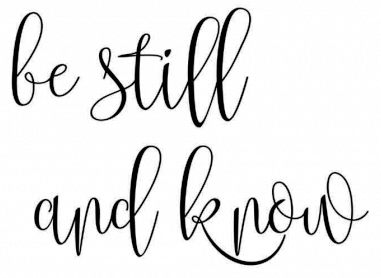
The Hebrew Scriptures advise us to know God by becoming still: ‘Be still and know that I am God’ (Psalm 46:10).

Who or what is God? Some dubious theological construct, one that some people have made up in their minds in an attempt to explain the mystery of life, but which doesn’t actually exist in objective reality? Well, the Bible elsewhere refers to God as the One ‘in whom we live and move and have our being’ (Acts 17:28). For me, ‘God’, when I use the word, which is not that often, refers to the one universal Presence and Power active in the universe, the medium (that is, order or level of reality) in which all things have their very be-ing-ness. God, if you choose to use the word at all – and you need not – is the Supreme Being, and we have our be-ing-ness, our very existence, in that Being.

Back to Psalm 46:10. There is so much in that short verse. The first thing to note is the importance of being still, if we are to come to know and experience the larger reality that the Bible refers to as ‘God’. In explaining this verse to people I sometimes break it up like this:

‘Be still and know that I am God’

‘Be still and know that I am 

‘Be still and know …’

‘Be still …’

‘Be …’

If you experience the verse – note that word ‘experience’ – that way I truly believe that you will come to know and experience what some choose to call God. You can call it whatever you like. It doesn’t really matter. As J. Krishnamurti used to say, over and over again, ‘The word [in this case, God] is not the thing.’ It’s the reality – the experience – behind and beyond the word that really matters. Indeed, it is all that matters.

One of my spiritual mentors was the late Dr Norman Vincent Peale. He helped millions of troubled people in his long lifetime. He gave some wonderful advice on how to still the mind and the body. He often said that you cannot still the mind until the body has become still. First, still--- that is, relax---the body, and then the mind will follow. Dr Peale wrote, ‘Sit still, be silent, let composure creep over you.' Then you will be still. That's why Psalm 46:10 says, 'Be still ...' It's not a matter of do-ing but be-ing.

Jesus preached the 'kingdom of God' (referred to in Matthew’s gospel as the ‘kingdom of Heaven’). For me, the Kingdom of God is that state of being and consciousness that is often referred to as the eternal now. There is an eternal, that is, atemporal, quality about the now. It is forever new. The present moment has its unfolding in the Now. The past is no more than the expression of a present reality, being a present ‘window link’ to the eternity of the Now. Any memories of the past are a present reality. It’s the same as respects the future, for any ideas about or hopes for the future are present ideas and hopes. You see, the present is simply that which presents itself before us in and as the Now. So, the present embraces past, present and future. What's more, the kingdom of God is not only a 'place' of inner strength and power, it's also a repository of stillness and quietude.

Back, once again, to Psalm 46:10. ‘Be still and know that I am God.’ First, the ‘knowledge’ spoken of is not book knowledge. Not at all. It is an inner knowing. Secondly, note those words ‘… I am God.’ Now, I am not saying that you and I are God, although I do say that you and I, as well as all other persons and things, have their be-ing-ness in God. Now, those words ‘I am God’. God is the Great I Am, that is, the presence and power of pure Being. What’s more, that pure Being is the very be-ing-ness of the person that you are.

When you enter the silence, you are approaching the very presence of be-ing – that is, sheer existence … the very livingness of life itself. The state of mind experienced in the silence is not one of passivity or non-action. No, it is a truly awakened state of mind and be-ing-ness in which all things are experienced as new and fresh in the omnipresent eternal now. 

In time, and with regular practice, the action of being fully and choicelessly present in the moment from one moment to the next – the essence of mindfulness and living mindfully – will quicken and intensify.

The essence of Christianity is the experience of coming to know God – the larger reality – in the form, and through the person, of Jesus. What’s so special about Jesus? Well, among other things, Jesus lived and was fully grounded in the eternal now. His strength, power and peace were the result of his being at-one with the source of all life and being, and his living fully in the eternal now. That is why he said, ‘My kingdom is not of this world’ (John 18:36). Now, as I see it, Jesus was not saying that his kingdom was on some supposed ‘higher’ order or level of reality. No, the kingdom of which Jesus spoke is one that that we enter when we live in the eternal now. It is the very reason why Jesus said that he had come.  ‘I have come that they may have life, and have it to the full’ (John 10:10). Abundant living. Living mindfully in the eternal now. Living selflessly. Living lovingly.

‘Be still and know …’


RELATED POSTS


Tuesday, November 1, 2016

STUDY SHOWS MINDFULNESS IMPROVES EMOTIONAL HEALTH

Neuroscientists from Michigan State University (MSU) have now presented clinical data suggesting the practice of mindfulness can help anyone deal with intensely emotional situations in a calm and balanced way, whether they are ‘naturals’ at meditation or undergo a crash course.

‘Our findings not only demonstrate that meditation improves emotional health, but that people can acquire these benefits regardless of their ‘natural’ ability to be mindful,’ said Dr Yanli Lin, lead author on the study. ‘It just takes some practice.’

The team asked 68 participants to either listen to an 18-minute audio meditation guide or a control presentation on learning a new language. Each person was then shown upsetting images, including photos of corpses, while hooked up to an electroencephalogram (EEG) which recorded their brain activity. All participants were female; the authors argued this meant they did not have to account for gender differences relating to regulating emotions.


The resulting scans showed ‘a significant reduction in LPP response to negative stimuli over time’, the authors wrote in Frontiers in Human Neuroscience. LPP stands for ‘late positive potential’, and refers to emotion-related activity in the brain’s visual cortex and how it is processed.

Previous studies have shown that LPP ‘reflects a global inhibition of activity in visual cortex, resulting in the selective survival of activity associated with the processing of the emotional stimulus’. It is part of an emotional coping mechanism, and in this study it was argued that it proved those who meditated could control their negative emotions and recover quickly.

The Michigan team found the results in the group that meditated were similar to those found in prior studies on ‘naturally mindful’ people, ‘suggesting that the benefits of mindfulness can be cultivated through practice’.

It seems that, like most other things, practice is the key to success. In that regard, the researchers found that when individuals were specifically instructed to ‘be mindful’, when looking at the distressing photos, the LPP was not impacted at all, ‘indicating that deliberate engagement in [a] state [of] mindfulness may not be an effective form of emotion regulation in meditation novices’.


Study: Lin, Y et al. ‘Deconstructing the Emotion Regulatory Properties of Mindfulness: An Electrophysiological Investigation.’ Front. Hum. Neurosci. 07 September 2016 | http://dx.doi.org/10.3389/fnhum.2016.00451


RELATED POSTS


MINDFULNESS HELPS TO CONTROL EMOTIONS ACCORDING TO NEW STUDY


MINDFULNESS DECREASES ANXIETY AND DEPRESSION IN CANCER PATIENTS


MINDFULNESS MAY ASSIST WITH BIPOLAR DISORDER

MINDFULNESS AND POST-TRAUMATIC STRESS DISORDER


MINDFULNESS TRAINING IMPROVES YOUR BRAIN


IMPORTANT NOTICE: See the Terms of Use and Disclaimer. The information provided on this blog is not a substitute for professional medical advice, diagnosis or treatment. Never delay or disregard seeking professional medical advice from your medical practitioner or other qualified health provider because of something you have read on this blog. In Australia, for immediate advice or support call Lifeline on 13 1 1 14, beyondblue on 1300 22 4636, or Kids Helpline on 1800 55 1800, and for information, advice and referral on mental illness contact the SANE Helpline on 1800 18 SANE (7263) or go online via sane.org. In other countries, call the relevant mental health care emergency hotline or simply dial your emergency assistance telephone number and ask for help.


Friday, October 21, 2016

MINDFULNESS TRAINING IMPROVES YOUR BRAIN

A new systematic review has looked at all studies published prior to July this year that investigated brain changes associated with 8 weeks of mindfulness-based stress reduction or mindfulness-based cognitive therapy.

The combined results suggest that a short course of secular mindfulness training leads to multiple brain changes similar in nature to those seen in people who have practised religious or spiritual meditation for a lifetime.

Rinske Gotink [pictured left] and her colleagues found 30 relevant studies that used MRI or fMRI brain imaging to look at the effects of mindfulness training on brain structure and function, including 13 randomly controlled trials.

Associated brain changes, in terms of activity levels and volume and connectivity changes, have been reported in the prefrontal cortex (a region associated with conscious decision making and emotional regulation and other functions), the insula cortex (which represents internal body states among other things), the cingulate cortex (decision making), the hippocampus (memory) and the amygdala (emotion).

Based on what we know about the function of these brain regions, Gotink’s team said these changes appear to be consistent with the idea that mindfulness helps your brain regulate your emotions.


Acknowledgments. This post is based on material appearing on the Readers Digest blog of the British Psychological Society.


RELATED POSTS

MINDFULNESS HELPS TO CONTROL EMOTIONS ACCORDING TO NEW STUDY


MINDFULNESS DECREASES ANXIETY AND DEPRESSION IN CANCER PATIENTS


MINDFULNESS MAY ASSIST WITH BIPOLAR DISORDER


MINDFULNESS AND POST-TRAUMATIC STRESS DISORDER


IMPORTANT NOTICE: See the Terms of Use and Disclaimer. The information provided on this blog is not a substitute for professional medical advice, diagnosis or treatment. Never delay or disregard seeking professional medical advice from your medical practitioner or other qualified health provider because of something you have read on this blog. In Australia, for immediate advice or support call Lifeline on 13 1 1 14, beyondblue on 1300 22 4636, or Kids Helpline on 1800 55 1800, and for information, advice and referral on mental illness contact the SANE Helpline on 1800 18 SANE (7263) or go online via sane.org. In other countries, call the relevant mental health care emergency hotline or simply dial your emergency assistance telephone number and ask for help.


Friday, October 7, 2016

MINDFULNESS HELPS TO CONTROL EMOTIONS ACCORDING TO NEW STUDY

Researchers from Michigan State University have found neural evidence that mindfulness helps to control negative feelings.

A group of 68 native English-speaking females, who had not practiced mindfulness meditation before, participated in the study. Analysis showed that participants came to the experiment with different levels of natural mindfulness.

Each participant wore an electrode cap, to enable EEG recording. They then took part in one of two 18-minute activities. Some listened to a guided meditation while others were exposed to a language-learning presentation. 

Immediately after the meditation the participants were shown some disturbing pictures. The participants were instructed to view the pictures either ‘mindfully’ or ‘naturally.’ The researchers used the EEG to record their brain activity while they were viewing the images.

Results indicate that, whether the participants had high or low levels of natural mindfulness, the brain was able to control negative emotions to the same extent. Exposure to the meditation session appeared to help the emotional brain to recover quickly after seeing the photos, suggesting that meditation enabled participants to tame their negative emotions.

The study tends to show that meditation can improve one’s emotional health and that even people who are not naturally mindful can acquire these benefits through the practice of mindfulness.


Study: Lin Y et al. ‘Deconstructing the Emotion Regulatory Properties of Mindfulness: An Electrophysiological Investigation.’ Front. Hum. Neurosci. 7 September 2016. http://dx.doi.org/10.3389/fnhum.2016.00451


RELATED POSTS


MINDFULNESS DECREASES ANXIETY AND DEPRESSION IN CANCER PATIENTS


MINDFULNESS MAY ASSIST WITH BIPOLAR DISORDER


MINDFULNESS AND POST-TRAUMATIC STRESS DISORDER


IMPORTANT NOTICE: See the Terms of Use and Disclaimer. The information provided on this blog is not a substitute for professional medical advice, diagnosis or treatment. Never delay or disregard seeking professional medical advice from your medical practitioner or other qualified health provider because of something you have read on this blog. In Australia, for immediate advice or support call Lifeline on 13 1 1 14, beyondblue on 1300 22 4636, or Kids Helpline on 1800 55 1800, and for information, advice and referral on mental illness contact the SANE Helpline on 1800 18 SANE (7263) or go online via sane.org. In other countries, call the relevant mental health care emergency hotline or simply dial your emergency assistance telephone number and ask for help.


Thursday, September 29, 2016

MINDFULNESS IS NOT CONCENTRATION

The great Indian spiritual teacher J. Krishnamurti [pictured right] spoke a lot about mindfulness without hardly ever mentioning the word. Listen to these words from his wonderful book Freedom From the Known:

‘Attention is not the same thing as concentration. Concentration is exclusion; attention, which is total awareness, excludes nothing. It seems to me that most of us are not aware, not only of what we are talking about but of our environment, the colours around us, the people, the shape of the trees, the clouds, the movement of water.’ 

Concentration is fixed and focused in a particular moment. Mindfulness, on the other hand, is a moment-to-moment activity … from one moment to the next and then the next and then the next and so on. 

Of course, we all need to concentrate from time to time on what we are doing. For example, we may be trying to balance a set of accounts or solve a legal or similar problem. We certainly need to concentrate when we’re engaged in any such activity. However, we do not need to concentrate as such each and every second of each and every minute of each and every hour of each and every day. What we need to do is to be attentive and aware of what’s happening in and around us.

A concentrated mind is anything but an attentive and aware mind. The concentrated mind excludes everything other than that the subject of your concentration. Awareness, on the other hand, is never exclusive. It is inclusive, universal and all-encompassing. Mindfulness — that is, bare (that is, diffused and unconcentrated) attention and choiceless (that is, non-judgmental and non-interpretative) awareness — is the direct, immediate and unmediated perception of ‘what is’ … as it actually happens from one moment to the next!

When we concentrate on something, we are totally blind, that is, inattentive, to all other things. Those other things quickly become the past without our ever having experienced them. Don’t let reality — that is, what happens from one moment to the next — die on you. Don’t experience it as a past event. Otherwise, you will instantly lose the immediacy, directness and actuality of the experience.

The Buddha advised us to observe and watch closely ... that is, mindfully ... whatever is occurring in time and space in the here-and-now, in the moment, from one moment to the next. Not only watch, but the Buddha went on to say, ‘and firmly and steadily pierce it.’

So, my friends, pierce the reality of each here-and-now moment-to-moment experience. Be attentive and aware. Only then can you say you are alive and no longer living in the past. Only then can you truly say you are living mindfully.