Showing posts with label Alice in Wonderland (book). Show all posts

Thursday, June 21, 2012

THE PROBLEM WITH ORGANIZED RELIGION

'Religion is a monumental chapter in the history of human egotism.'
- Professor William James.

The following comes from the great spiritual philosopher Jiddu Krishnamurti (pictured left):

‘You may remember the story of how the devil and a friend of his were walking down the street, when they saw ahead of them a man stoop down and pick up something from the ground, look at it, and put it away in his pocket. The friend said to the devil, "What did that man pick up?" "He picked up a piece of Truth," said the devil. "That is a very bad business for you, then," said his friend. "Oh, not at all," the devil replied, "I am going to let him organize it."’

There are many problems with organized religion---indeed, with anything that is ‘organized.’ As Krishnamurti often pointed out, Truth cannot be organized. Krishnamurti famously said:

‘I maintain that Truth is a pathless land, and you cannot approach it by any path whatsoever, by any religion, by any sect. That is my point of view, and I adhere to that absolutely and unconditionally. Truth, being limitless, unconditioned, unapproachable by any path whatsoever, cannot be organized; nor should any organization be formed to lead or to coerce people along any particular path. If you first understand that, then you will see how impossible it is to organize a belief. A belief is purely an individual matter, and you cannot and must not organize it. If you do, it becomes dead, crystallized; it becomes a creed, a sect, a religion, to be imposed on others. This is what everyone throughout the world is attempting to do.’

So, the main problem with religion---all religions---is just that. They all try to organize Truth in one way or another. Some even go so far as to assert that their particular 'version' of Truth---they never actually say 'version', but that's what it is---is the one and only 'true' one. That is why most religions insist upon uniformity, conformity, fidelity---and obedience. Fortunately, more and more people are coming to realize that no one can have  a monopoly on Truth---for Truth just is.

The adherents of organized religion think that they are free, but they are not. They are in bondage. They are in prison. And most of them are oblivious to the fact of their bondage and imprisonment.


First, the adherents of organized religion are in bondage to beliefs. The Pāli word ditthi is wide enough to embrace beliefs, views, thoughts, ideas, theories, opinions, and doctrines. All of these things are thought coverings or veils (āvarnas). That is how Shakyamuni Buddha referred to them. These thought coverings or veils do not reveal reality, indeed they block and distort reality. How? Well, they prevent us from knowing and experiencing things as they really are in all their directness and immediacy. Everything gets 'filtered' down to us through our beliefs and opinions---and through the distorting prism of dogma. As I've said so many times, beliefs and dogmas are a menace to society---and a total, impenetrable barrier to true knowledge and wisdom. Beliefs and dogmas are always someone else's 'version' of reality---the result of someone else's conditioned mind, mental habits and fragmentary thinking, that is, the past. There is nothing of any value to believe, and there is nothing to be gained by believing anything or anyone. Just observe. Then you will know---and understand.  that regard, Buddha got it right. He said, 'Do not believe, for if you believe, you will never know. If you really want to know, don't believe.' (To me, the Buddhist approach to Truth or reality is so much better than Christianity's 'believe and be baptized' [Mk 16:16].)

Secondly, the adherents of organized religion are in bondage to superstition. The amount of superstition in religion varies greatly from one religion to another. Despite what I have just written about Buddhism, I have found, at least in some Buddhist sects or denominations, a lot more superstition than in most traditional forms of Christianity. That is quite disconcerting.

Why is superstition a problem? The answer is obvious. Superstition is a distorted, falsified view of reality. Superstition asserts the existence of a mechanical luck-ridden world which is said to be responsive to our own individual or collective thoughts, ideas and prayers. This is not the case in reality. For the most part, the world is indifferent---and sometimes downright hostile---to our very being. Superstition is nothing more than ‘magical thinking.’ According to anthropologist Dr Phillips Stevens, Jr (pictured right), magical thinking involves several elements, including a belief in the interconnectedness of all things through 'forces' and 'powers' that supposedly transcend both physical and spiritual connections. Magical thinking invests special powers and forces in many things that are seen as symbols. According to Stevens, ‘the vast majority of the world's peoples ... believe that there are real connections between the symbol and its referent, and that some real and potentially measurable power flows between them.’

Thirdly, the adherents of organized religion are in bondage to ‘holy books’ and ‘sacred scripture.’ Now, don’t get me wrong. I have enormous respect for the sacred texts of the world’s religions, provided those texts and their teachings are read, interpreted and applied rationally and humanely, and the underlying ‘myths’ are properly and sensibly understood. For example, much of the books comprising the Bible are written in figurative, metaphorical, allegorical, symbolical and spiritual language, and must be interpreted and applied in that manner in the light of reason and contemporary knowledge.  However, I make no claims of infallibility or inerrancy for any of those sacred texts, nor will I slavishly follow them where reason or common sense---or simply the results of my life experience---suggest they are wrong. A statement is not true merely because it is in the Bible---or in the Qur'an, or whatever. How silly to think or believe otherwise!

Fourthly, the adherents of organized religion are in bondage to ‘teachers,’ ‘saviours,’ and ‘gurus’ of various kinds. Some are guided by their Pope, their parish priest, or their pastor expounding the Word of God. Others are guided by the ‘Holy Spirit.’ Still others are guided by teachers and leaders of other kinds. To the extent that these persons accept, at face value, the views or teachings of others in authority---whether temporal or spiritual---they do not think for themselves, but simply accept another person’s version or understanding of reality. The latter can never be reality itself but only a false substitute for it---a counterfeit reality, if you like.

Fifthly, the adherents of organized religion are in bondage to rites and ceremonies of various kinds. Truth cannot be concretized in any way. If you try to do that, Truth ‘dies’ on you. Yes, rituals of various kinds can be hugely transformative---I have seen the power of that in my own life and in the lives of many others. The important thing is not to lose sight of the bigger picture. Rites and ceremonies are simply a means to an end. Ritualists and ceremonialists tend to lose the plot. (When I was in holy orders in the Liberal Catholic Church---a highly ritualistic church which is very much open to the ideas of mysticism and extra-sensory experience---we had some old members say, ‘Every word of our Liturgy has been clairvoyantly inspired, so we must not change a word or syllable of it.’ That’s one of the reasons why I am no longer a part of that church, although there is much that is wonderful in and about it.)

As a Unitarian as well as a practising Buddhist, I cherish religious naturalism and the use of reason and free thought. For me, the sacred or holy is ordinarily to be found in the ‘ordinary’ as opposed to the ‘extraordinary,’ in the ‘natural’ as opposed to the supposedly ‘supernatural.’ Truth is all around us, and is us. We can never be out of contact with Truth or reality. We are always in direct and immediate contact with Truth as it unfolds as our life’s experience from one moment to the next. Do not seek Truth afar. It is right here---now!


Note. Here is a wonderful address from Buddhadasa Bikkhu (pictured left) entitled The Prison of Life. I have derived great benefit from reading and studying it. I hope you do, too.


Acknowledgment is made, and gratitude is expressed,
to the Krishnamurti Foundation of America, Ojai, California, USA.


RELATED POSTS


Friday, June 15, 2012

ALICE IN WONDERLAND: THE ANCIENT WISDOM


‘Not only is the universe stranger than we imagine,
it is stranger than we can imagine.’ - Sir Arthur Eddington.


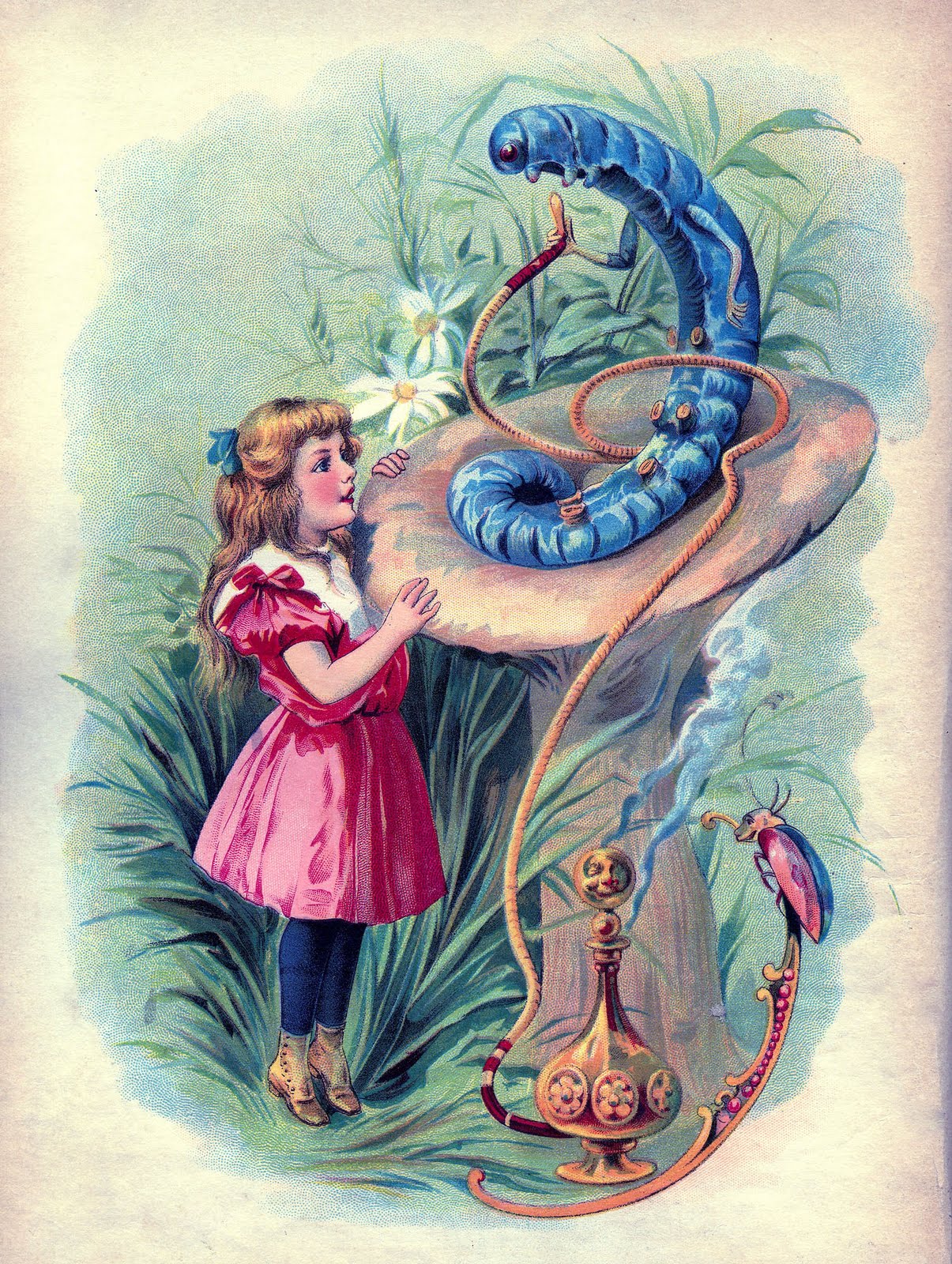
Much has been written about Lewis Carroll’s tale Alice's Adventures in Wonderland and its sequel Through the Looking-Glass. Suffice to say that we have more here than just stories for children. The books' encoded subtexts are full of ancient esoteric and literary symbology. (Take, for example, the symbolism of the ‘White Rabbit,’ with its connotations of purity, spiritual awakening and new life, not to mention, even more importantly, the Rabbit's role as an adept and a psychopomp (that is, a liaison and guide to the 'Underworld') and as a representation of using one's intuition. Then there’s the ‘golden key,’ the hookah-smoking mind-reading Caterpillar on top of the mushroom [deliciously 'occult'!], red roses (and the Alice-like flower with its crown of thorns), the many calls to 'Drink me' and 'Eat me,' the riddle 'Why is a raven like a writing desk?', Alice's automatic (?) writing, and so on. I must stop there for the time being. I digress. Please forgive me---OK, don't.)

Before I get started---yes, I know, I already have---here (courtesy of the BFI National Archive) is a 2-minute selection of clips from the first-ever film version of Alice's Adventures in Wonderland. Made in 1903---just 37 years after Lewis Carroll wrote his novel and 8 years after the birth of cinema---this film was the longest film produced in England at that time:


Lewis Carroll---real name, Charles Lutwidge Dodgson (pictured below left)---had a great interest in the ‘occult’ and, in particular, in Rosicrucianism and in what is sometimes referred to as the ‘Ancient Wisdom’ (or the ‘perennial philosophy’), and what we have in both Alice and Through the Looking-Glass is a literary outworking of the archetypal story of the hero or initiate's journey, as well as the Gnostic redeemer myth, and the allegory of the descent ('involution') and ascent ('evolution') of the human soul.

One version of the Gnostic redeemer myth goes like this. Sophia is said to have accidentally created the physical world but, in so doing, she becomes trapped and unable to return to the heavens. We, too---along with our heroine Alice who falls into a rabbit-hole---are trapped in time and space. In that sense---and that sense alone---we are ‘fallen’ souls. That is the price one pays for ‘spirit’ descending into ‘matter.’

Perhaps more significantly, we are trapped by the delusion of ‘self,’ that is, the misbelief that there is, at the core of our being, a separate, independent, unchanging ‘self’ or ‘personality.’ Alice's quest is also ours---'Who in the world am I? Ah! That's the great puzzle! Who am I?' she asks. Well, Alice (from the Greek for 'truth'---a name must mean something, as Humpty Dumpty pointed out in Through the Looking-Glass) learns, in the course of her journey---the ‘fall’ or ‘descent’ into Wonderland---that there is no such thing as an unchanging ‘self.’ Take, for example, this piece of wisdom: ‘I can't go back to yesterday - because I was a different person then.’ All through the Alice books we see Alice changing in ‘size,’ which is a way of saying that our sense of self (the thousands of ever waxing and waning ‘I’s’ and ‘me’s’ in us) is inherently unstable and constantly changing.

Lewis Carroll makes it clear that there is a ‘way out’ of existential confusion. There is a ‘golden key.’ We must discard the whole idea of ‘self’ or ‘ego.’ Remember the Cheshire Cat? The Cat vanishes, leaving nothing but a grin. What a wonderful image of the illusory nature of the ‘self’ as well as the impermanence of all things! No wonder the great physicist, astronomer and mathematician Sir James Jeans wrote, ‘The universe begins to look more like a great thought than a great machine.’ Lewis Carroll is fascinated with the mind and its workings, and with 'altered' states of perception. In Through the Looking-Glass the author has the Knight say, 'What does it matter where my body happens to be? My mind goes on working all the same.' Not only that, but, if the Alice books 'prove' anything, the conscious mind can at times become completely 'lucid' to the unconscious. At any rate, the Alice books make it clear that we need to see things in a different way---or at least see things as they really are---in order to find ourselves. The connection with mindfulness meditation (vipassanā) is clear---there are different ways of seeing. That is what the word vipassanā means. The word is composed of two parts vi, meaning ‘in various ways’, and passanā, meaning seeing. So, vipassanā means ‘seeing in various ways’ ... as well as seeing things as they really are.

Back to the ever-vanishing Cheshire Cat. (I will be like the proverbial kid in the lolly shop in this post. Forgive me.) It is the Cat---a symbol of divine wisdom in Ancient Egypt---who tells Alice to take a 'short cut' and go to the Queen. ('Some go one way, and some go another way, but I always take the short cut.') Very sound advice, this Cat gives. Now, remember when Alice plays croquet with the Queen of Hearts? Croquet---with flamingos for mallets and hedgehogs for balls. Quaint. Well, the Queen is in all of us. (No, not in that sense. Sorry.) The Queen has that mentality held by so many of us---she must always win or succeed, no matter what. She gets terribly angry even at the thought of ‘losing’ the game. That is why the Queen's playing card guards make sure the Queen’s ball goes through the hoops every time. That is the way the ego-self ‘works’---self-will run riot. The 'don't mess with me' mentality.

The Queen is our ego-self, and our identification with that ‘self’ as being supposedly who we really are. Later, there is the trial---to determine who stole the tarts from the King and Queen---and Alice learns a very important spiritual and psychological truth. ‘You’re nothing but a pack of cards,’ Alice accuses the characters, who rise up and fly at her. Wow! Alice has a spiritual epiphany of sorts, and comes to know the true nature of existence---namely, everything is impermanent.

When Alice first meets the Queen, she says to the Queen, ‘I’ve lost my way.’ The Queen retorts, ‘Your way? … All the ways round here belong to me!’ Ha! The tragedy of self-obsession and self-absorption. When the Queen trips over her own mallet---such is the nature of self-centredness---she must always blame someone else (in this case, Alice). Alice sees through the nature of the Queen, and shrinks back to normal size. Ego deflation at great depth has occurred. That is always the essential prerequisite for true spiritual growth and development. It is the hallmark of the ‘conversion’ or ‘initiation’ experience. Alice finds herself in a maze. She runs and runs, and eventually sees a tiny door. The ‘door’ is always tiny---like the proverbial camel through the eye of a needle. Alice looks through the keyhole---remember, no matter how far we have fallen or strayed, we can always get a glimpse of the way out---and she sees … herself … asleep under a tree. Alice hears a familiar voice calling her name. She opens her eyes. She ‘awakens.’ What powerful imagery! The ego-self has gone. In its place, there is the authentic self---the person that each of us really is.

When Alice first falls into the rabbit-hole, there is darkness. Naturally. Cupboards, bookshelves, pictures, lamps and mirrors all float past Alice as she falls. These things represent everything that holds us back. If we would travel far, we must travel light. Material and earthly things---and even our intellect and sense of ‘self’---hold us back. We must let go of all these things if we want to ‘see’ and ‘know’ things as they really are. Like Alice, we must remain forever ‘curious,’ for curiosity---one of the important features of a ‘mindful’ mind---is essential if we would see things choicelessly as they really are.

There is so much in Alice of lasting importance. Remember the Mad Hatter’s tea-party, attended also by the March Hare and the Doormouse (all of whom are 'mirrors to the mind' in one way or another)? They are celebrating an ‘un-birthday’ (or 'non-birthday'), which is any day that’s not one’s birthday. What a powerful image of the nature of unreality (that is, the illusory nature of existence). An un-birthday is when nothing happens, but nothingness---that is, ‘no-thing-ness’---is everything! When we come to know the no-thing-ness of all reality, we can truly say we have come to know the Self---that is, the very self-livingness of life---as one.

And what of so-called ‘time’? The watch-carrying White Rabbit provides a launching pad for an exploration of the nature of time and eternity. ‘Time’ and ‘space’---which are really one---are no more than mediums in which all things exist. Life itself is timeless and spaceless, with everything contained within ‘the Now.’ All duration---or time---is total and complete in the Now.  In Through the Looking-Glass we find the Red Queen crying 'Faster!' and 'Faster!' as Alice runs hand in hand to keep up with her. We read, 'The most curious part of the thing was that the trees and the other things round them never changed their places at all: however fast they went, they never seemed to pass anything. "I wonder if all the things move along with us?" thought poor puzzled Alice.' Also, at the Mad Tea-Party Alice is told by the Hatter, 'It's always six o'clock now.' Yes, there is an ‘eternal’ quality about the Now. It is forever new.

And what of the ‘path’? Well, there are lots of paths in Alice, but none of them really lead anywhere. Funny, that. In Through the Looking-Glass Alice remarks, 'Here's a path that leads straight to [the garden of live flowers] ... no, it doesn't do that ... how curiously it twists! It's more like a corkscrew than a path!' And so we find Alice 'wandering up and down, and trying turn after turn.' So must we. We must never become complacent and settle for just one 'version' or 'brand' of Truth---say, the church or religion we were 'born' into. Alice asks Tweedledum and Tweedledee, 'Which is the best way out of [the] wood?' The fat little men 'only looked at each other and grinned.' Love it!

The paths taught by so-called experts---the priests, teachers, saviours and gurus---are not the true path. They represent other persons’ versions or ‘understanding’ of reality, and they are of no use to us. At one point---one of many such points---Alice has had enough of Wonderland, and wants to go ‘home.’ However, she can’t find her way out. She finds a path to follow, but a dog with a broom comes along and sweeps the path away. Ha! Isn’t that always the case? But that’s a good thing, really. We don't need paths---at least not those sorts of paths. Truth is a pathless land, as the iconoclastic Krishnamurti pointed out more than once. (Why? Because we are always in direct and immediate contact with 'Truth' or 'reality' at all times. There is no separation or distance to be made the subject of a path or otherwise 'bridged' by some supposed mediator or saviour. Sad we don't realise that to be the case.)

Alice then hears the voice of the Cheshire Cat, telling her to go to the Queen. The Cat refers to a ‘short cut,’ and it is that which I have referred to above---namely, the letting go of the notion of self altogether, with all that entails. That is indeed the short cut, and the moment-to-moment practice of mindfulness is a wonderful means of freeing oneself from the bondage of self. In a very profound sense there is no path, for---as mentioned above---a path presupposes a separation or distance between the person that each of us is and reality (or Truth) itself. The only apparent separation or distance is the illusion of self, which we must eliminate. The Queen constantly shrieks, ‘Off with her head!’ However, it is the Queen’s head---the ego-self---which must be topped.

Alice learns that not only is there no ‘path’ as such---except the ‘short cut’ referred to above---there are also no ‘rules.’ (Carroll eschews moralising, unlike others such as C S Lewis.) Alice’s encounters demonstrate that. Words tend to mean whatever we want them to mean. Yes, we invariably get lost in our own self-constructed mental prison of ego-self---a veritable Jabberwock which must be overcome ('killed') if there is to be any progress at all. The good news, as Dr Norman Vincent Peale used to say, is that there is in each of us a spiritual giant which is always trying to burst its way out of the prison we have made for it. This spiritual giant---as I see it---is not something ‘supernatural’ (whatever that means) but nothing other than the conscious recognition or awareness that ‘self cannot change self.’

Along the ‘way’ Alice finds some spiritual nourishment in some bits of mushroom. Love it! Then there’s the associated Zen kōan in the form of the Caterpillar’s advice about the mushroom, ‘One side will make you grown bigger and the other side will make you grow smaller.’ Alice asks, ‘One side of what? The other side of what?” ‘Of the mushroom,’ says the Caterpillar.

That reminds me of the old Buddhist story, ‘You are on the Other Side.’ Reason, intellect, and book knowledge---not unimportant things by any means---are not the ‘short cut’ described by the Cheshire Cat. Indeed, they are hindrances to spiritual growth, as are all the things that the world deems important. The latter---along with those who seek worldly fame and success---are not only deluded, they’re ‘nothing but a pack of cards.’

Lewis Carroll takes a not-so-gentle swipe at the silliness of beliefs. 'I can't believe that!' says Alice to the White Queen. The latter says, 'Can't you? ... Try again: draw a long breath, and shut your eyes.' Alice laughs and says, 'There's no use trying ... one can't believe impossible things.' Not so, says the Queen. 'I daresay you haven't had much practice ... When I was your age I always did it for half-an-hour a day. Why, sometimes I've believed as many as six impossible things before breakfast.' So do multitudes of adherents of organized religion. They, too, 'draw a long breath and shut [their] eyes,' believing 'as many as six impossible things before breakfast.' Shakyamuni Buddha referred to beliefs  as thought coverings or veils, which block and distort reality, and thus prevent us from knowing and experiencing things as they really are in all their directness and immediacy. In addition, beliefs are always someone else's 'version' of reality---the result of someone else's conditioned mind, mental habits and fragmentary thinking, that is, the pastBuddha got it right, saying, 'Do not believe, for if you believe, you will never know. If you really want to know, don't believe.' Even if, like Alice, you 'don't quite understand,' always remember this---'It gets easier farther on,' as Humpty Dumpty pointed out in Through the Looking-Glass. Such is the reality of knowledge, experience and understanding.

Alice finally masters the underworld ('Wonderland' or the 'Looking-glass world') and becomes an 'initiate.' She awakens to her true 'be-ing' and full potential as a human being. She comes to know Truth. You can, too.

Choose---like Alice---to be mindfully different. And don’t forget the short cut.


Notes

1. Some of the scenes described in this post come from Lewis Carroll’s writings while others come from other literary as well as cinematic versions of Carroll’s works.


2. On 20 June 2015 the talented Australian broadcaster Jamie Travers interviewed me on 2SER - Real Radio 107.3 FM in connection with the 150th anniversary of the publication of the book Alice's Adventures in Wonderland. Here's a link to the interview


RELATED POSTS


THE EMERALD CITY REALLY IS GREEN


A SPIRITUAL GUIDE TO MINDFUL LIVING