One
of my life-long interests (academic and otherwise) has been burlesque---especially
the ‘old school,’ ‘golden age,’ classical type of American burlesque with, yes,
a moderate amount of striptease---provided it is more ‘tease’ than ‘strip’---as
well as, most importantly, baggy pants comedy that goes to the right degree of anarchic
bawdiness and surreal silliness.
Famed
ecdysiast (that is, stripper) Ann Corio [pictured left], who was sometimes
referred to as the ‘Queen of Burlesque,’ once said---indeed, she said it many times---that burlesque without the
comedy and the comics was, well, not burlesque at all. I tend to agree. Modern-day
burlesque, for the most part, is little more than no-holds-barred, bare-faced
(and bare everything else) striptease, the sole aim of which is erotic
stimulation. (Don’t get me wrong. I’m no prude.) Gone are the comics---with only
a few exceptions. Go back to the start of last century, and the burlesque comic
was the acknowledged star of the
show. Of that there was no doubt. Even the strippers were conscripted into the
blackout sketches as walk-ons or in more substantial roles. For example, the
one and only Gypsy Rose Lee, in her later years, proudly recalled playing small
comedic roles in such sketches as ‘Floogle Street’ (see below) and the
Kafkaesque ‘Pay the Two Dollars’ (the latter written by Billy K Wells [burlesque’s most proficient writer] and comic Willie Howard, based on an idea by Finley Peter Dunne, Jr), two of my favourite
‘bits.’

Vaudeville
had its ‘circuits,’ and burlesque had its ‘wheels.’ Both had their comedians or
comics. Some of the great burlesque comedians in the United States of America
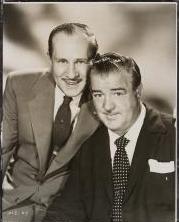
were Abbott and Costello [pictured right], The Three Stooges, Joe Besser
and Joe DeRita (both of whom, in their later years, were also members, one
[DeRita] after the other [Besser], of The Three Stooges [as ‘Joe,’ and ‘Curly-Joe,’
respectively], with DeRita having also worked in burlesque with both Bud Abbott and Red Skelton), Gallagher and Shean (Al Shean being the uncle of The Marx Brothers), Will Rogers, W C Fields, Fanny Brice, Sophie Tucker, Al Jolson, Eddie Cantor, Joe Weber and Lew Fields, Sid Fields, Joe E Brown, Ed Wynn, Murray Leonard, Leon Errol, Smith and Dale, Harry ‘Zoup’ Welsh, Bert Lahr, Rags Ragland, Buster Keaton, Joe Penner, Red Buttons, Red Skelton, Danny Kaye, Jack Albertson, Jimmy Durante, Milton Berle, Jackie Gleason, Danny Thomas, Phil Silvers, Joey Faye, Herbie Faye, Joe E Ross, Morey Amsterdam, Robert Alda, and even Bob Hope (whom I saw perform in Sydney,
Australia on two different occasions). They were all giants of both physical and
verbal comedy---and I have laughed at them all. (‘Poor you,’ I hear some
readers saying, or at least thinking. Others will be saying, ‘Who the hell are
those people?’ All I can say in reply is, ‘You crazy, youuuuu!’ [with more than a
little nod to the late Joe Besser].)
Now,
in his wonderful book The Best Burlesque Sketches the late Ralph Allen wrote:
… The
Burlesque show appeals to our inner passion for anarchy. It appeals also to our
desire to renounce the painful effort of intelligence and behave as creatures
of instinct not of will. …
The
structure of a typical burlesque scene is a critique of common sense. And a
critique also of sentiment. Pathos, of course, is another form of moral
restraint, and Burlesque delighted in making fun of it.

Advertisement, Empire Theatre, Newark, New Jersey
Take, for example, the famous burlesque chestnut known as
‘Floogle [sometimes spelled ‘Flugel,’ 'Flugle' or ‘Fleugel’] Street’ (and also known as
‘Which Way is Floogle [ditto] Street?’). A variant of it, as performed in the
Abbott and Costello film In Society,
is ‘Bagel Street’ (which is also known as ‘Susquehanna Hat Company’). In the A&C version, every
time the words ‘Bagel Street’ or ‘Susquehanna Hat Company’ are spoken by the
hapless patsy Lou Costello (who is trying to deliver a carton of straw hats to
the Susquehanna Hat Company [or, in some versions, the Paskuniak Hat Company] located on that street), some third person in the
form of a passerby---and there are several such passersby in the course of the
routine---goes into a monomaniacal rage or frenzy. (The background to this
routine is interesting, involving a strike at a hat factory, and a person who
is hired as a strikebreaker without knowing it. He’s the one delivering the
hats to the hat company, only to be confronted by a number of very angry
strikers---the poor schlemiel. The story was reworked in burlesque for comic effect.) Anyway, here
is one version of the immortal sketch,
this one taken from In Society ...
It has been noted that quintessential burlesque sketches such
as ‘Floogle Street’ feature other thematic displays---some of them being tasteless
and quite politically incorrect these days---for example, displays or at least
suggestions of such things as nymphomania (hypersexuality), necrophilia, tic douloureux (trigeminal neuralgia), and
cleft palate. Some of these can be seen in the A&C version above. It seems
that the secret of burlesque is this---the more tasteless the better. There is
no place for any pity, pathos or sentimentality in burlesque comedy. Those
emotions are full of moral pretence, and burlesque has no time for moralising
of any kind.

Having said that, most, if not all, of these classic well-travelled and widely copied routines routines were the work of a number of people over time, with later comedians adding their own peculiar shtick to the work of others. In this sketch the comic meets a down-and-outer (the straight man) whose life---and sanity---have been ruined by his unfaithful wife. The down-and-outer goes into an absolute frenzy just at the mention of the words ‘Niagara Falls,’ being the place where he caught his wife and the guy who stole her from him ...
‘Niagara Falls! Slow-w-ly I turned. Step by step---inch by inch---I crept upon him. And when I got close enough I grabbed him by the throat---and I choked him--- (Beats up on COMIC.) ---and I hit him and strangled and bit and kicked and--- (COMIC is on the floor---STRAIGHT MAN suddenly comes out of it.) Oh! What are you doing down there?’
Here, then, is a near-seamless presentation of one version of this time-honoured standard routine, masterfully performed
by the great Sid Fields (who wrote a version of the routine that has been
performed by many great performers over the years) and the hapless patsy Lou Costello:
For
those who are interested, here’s another version of the routine, done by TV greats Lucille Ball and Phil Silvers with great timing and precision ...
'Floogle Street' and 'Niagara Falls' are a type of burlesque sketch known as 'The Rave,' in which the performer gets dramatic and rants and raves. Frustration and rage are the defining emotions in these sketches.
And this post would not be complete without a passing reference to the surreal ‘Crazy House’ (also known as the ‘Nut House’) sketch in which, in one popular version of the sketch performed often by Abbott and Costello, our comic anti-hero checks himself into a 'clinic' to get some rest, only to be confronted and humiliated by the increasingly zany and anarchic antics of a series of grotesque walk-ons and their various bizarre and intrusive set-ups. In the original form of the sketch an applicant for a job in a mental hospital is mistaken for one of the inmates. This brilliant old warhorse also reveals old-time burlesque’s fascination with insanity, mental asylums, ‘rest homes,’ and so-called ‘crazy people.’ Remember, these were very early days for psychiatry, which was yet to be recognised as a separate medical specialty in its own right. (In many hospitals, the mental health needs of patients were attended to by neurologists.) Oh, there’s also this version of ‘Crazy House’ presented by Ann Corio. It’s very faithful to the way it was usually done in the burlesque houses of yesteryear ...
All of these absurd, but very funny, burlesque sketches have one thing in common. Well, they have many things in common, but this one is very important to the achievement of the overall humour, namely, that there is, in both form and content, an ever-escalating sense of unreality. The sketch builds and builds in silliness, and you get swept along with it all. You see, for all the anarchic and uninhibited silliness, good burlesque comedy has a certain logic about it---an internal order, structure, and overall coherence. It is never static, but always dynamic. It is a living thing … and it is a work of art. That is how I and many others see it. I never get tired of watching these skits over and over again. They are so very clever---and funny---and they hold a mirror up to life, enabling us to become aware of life’s ‘as-it-is-ness’ … in all of its gross absurdity.
'Floogle Street' and 'Niagara Falls' are a type of burlesque sketch known as 'The Rave,' in which the performer gets dramatic and rants and raves. Frustration and rage are the defining emotions in these sketches.
And this post would not be complete without a passing reference to the surreal ‘Crazy House’ (also known as the ‘Nut House’) sketch in which, in one popular version of the sketch performed often by Abbott and Costello, our comic anti-hero checks himself into a 'clinic' to get some rest, only to be confronted and humiliated by the increasingly zany and anarchic antics of a series of grotesque walk-ons and their various bizarre and intrusive set-ups. In the original form of the sketch an applicant for a job in a mental hospital is mistaken for one of the inmates. This brilliant old warhorse also reveals old-time burlesque’s fascination with insanity, mental asylums, ‘rest homes,’ and so-called ‘crazy people.’ Remember, these were very early days for psychiatry, which was yet to be recognised as a separate medical specialty in its own right. (In many hospitals, the mental health needs of patients were attended to by neurologists.) Oh, there’s also this version of ‘Crazy House’ presented by Ann Corio. It’s very faithful to the way it was usually done in the burlesque houses of yesteryear ...
All of these absurd, but very funny, burlesque sketches have one thing in common. Well, they have many things in common, but this one is very important to the achievement of the overall humour, namely, that there is, in both form and content, an ever-escalating sense of unreality. The sketch builds and builds in silliness, and you get swept along with it all. You see, for all the anarchic and uninhibited silliness, good burlesque comedy has a certain logic about it---an internal order, structure, and overall coherence. It is never static, but always dynamic. It is a living thing … and it is a work of art. That is how I and many others see it. I never get tired of watching these skits over and over again. They are so very clever---and funny---and they hold a mirror up to life, enabling us to become aware of life’s ‘as-it-is-ness’ … in all of its gross absurdity.

Steel Pier (Atlantic City, New Jersey) handbill from 1938.
Note that the two famous comedy teams The Three Stooges
and Abbott and Costello were appearing in different stage shows
at the Steel Pier at the same time.
at the Steel Pier at the same time.

Billy Minsky's Republic Theatre, 42nd Street, New York City
Now, what has all this burlesque comedy stuff got to do with mindfulness, you may be asking? Well, as I see it, we are all a bit monomaniacal. ‘Speak for yourself, Ellis-Jones!’ Well, I am---and whether you like it or not I am also speaking for you … and you … and you. You see, we all get ourselves into a state---or our minds tend to get fixated on some more-or-less automatic reflex thought, idea, emotion, or memory---that goes into flight when the right trigger presents itself. ‘Snap’ … and there’s the reaction. It’s like this. We experience a ‘sensation’ of some sort or other, which may be physical or mental (including, of course, emotional). If we react to that sensation with ‘liking’ or ‘disliking’---that is, with craving, attachment or aversion---that is karma. The word karma means 'action'---in this case mental action in the form of a mindless, involuntary reaction to some input. The result? Pain, suffering, distress, frenzy … and even temporary insanity! However, if, on the other hand, we simply allow ourselves to be dispassionately and choicelessly aware of the sensation, then there is no ‘cause’ to produce any pain, suffering or distress. In other words, no reaction, no cause … and no effect.
 The
important thing, as I see it, is to take the cause-and-effect process back one
step earlier. In much self-help literature, the primary emphasis is on
avoiding negative thinking, and instead thinking positively, and the like, the
rationale being that negative thoughts lead to negative results, whereas positive
thoughts will inevitably lead to positive results---an obvious
but debatable proposition. However, if we go back a step, and
when something happens we simply do not allow
a reaction (eg liking or disliking) to arise in the first
place. In other words, we simply let the sensation (input) be.
Then there will be no opportunity for any negative thought to arise at all. That is
the way the so-called 'law' of karma really works. That is
the way to mindfully ‘work’ the law of cause and effect (or 'sowing and
reaping').
The
important thing, as I see it, is to take the cause-and-effect process back one
step earlier. In much self-help literature, the primary emphasis is on
avoiding negative thinking, and instead thinking positively, and the like, the
rationale being that negative thoughts lead to negative results, whereas positive
thoughts will inevitably lead to positive results---an obvious
but debatable proposition. However, if we go back a step, and
when something happens we simply do not allow
a reaction (eg liking or disliking) to arise in the first
place. In other words, we simply let the sensation (input) be.
Then there will be no opportunity for any negative thought to arise at all. That is
the way the so-called 'law' of karma really works. That is
the way to mindfully ‘work’ the law of cause and effect (or 'sowing and
reaping').
So,
how best can we prevent or avoid that mindless,
involuntary, seemingly automatic, even unconscious, reaction to some input
(whether internal or external)?
Well, cognitive behavioural therapy can
assist, as can other forms of psychotherapy as well as mental cultivation of
various kinds. Mindfulness can be particularly helpful, because it teaches us
to ‘watch,’ ‘observe,’ and ‘wait.’ Instead of reacting like some sort of
automaton we learn to simply be aware---choicelessly.
Yes, it takes time, and much practice, but we can teach ourselves to put some
‘space’ or ‘distance’ between the observing person
each of us and the event---internal or external---that, but for a mindful mind,
results in a reaction.
Burlesque
is a mindset and an attitude---and a way of looking at life, with directness
and immediacy. So is mindfulness.
‘Slow-w-ly
I turned. Step by step---inch by inch.’ Well, put some slow-w-ness---that is, watchfulness---into the turning
of your mind … from one moment to the next. It will work wonders in your life.
IMPORTANT NOTICES
1. See the Terms of Use and Disclaimer. The
information provided on this blogspot is not a substitute for professional
medical advice, diagnosis or treatment. Never delay or disregard seeking
professional medical advice from your medical practitioner or other qualified
health provider because of something you have read on this blogspot. For
immediate advice or support call Lifeline on 13 1 1 14 or Kids Helpline on 1800
55 1800. For information, advice and referral on mental illness contact the
SANE Helpline on 1800 18 SANE (7263) go online via sane.org
2. Images of Lucille Ball are licensed by Desilu, too, LLC. Licensing by Unforgettable Licensing. All Rights Reserved. The licensable images of Abbott and Costello, the routine ‘Who's on First’ and other routines and materials of and by Abbott and Costello are controlled material of the Estates of the Late Bud Abbott and the Late Lou Costello. All rights reserved. The various clips (courtesy YouTube) are presented here for entertainment, nonprofit and non-commercial purposes only. There is no intention to infringe copyright or any other controlled material. This post, and the blog site itself, are solely for informational and educational purposes that are entirely non-profit and non-commercial in nature, intent and actuality.
RELATED POSTS