Showing posts with label No-mind. Show all posts

Thursday, January 22, 2015

HOW EMPTY IS YOUR MIND?

Is there a ‘secret’ to successful living? I have come to the view that there isn’t. Certainly, there is no one thing that must be done, or not done, in order to live a happy and fulfilled life. However, having said that, there is one thing which seems to me to be of great, even paramount, importance. It is this---live in the now. The now is the portal through which we experience the present moment, indeed every moment.

All too often we ‘live’---if you can call it living---in either the past or the future. We all know that is not the way to live, but we all do it. Many books have been written in recent years about the importance of living in the now … so many books that you would think it is a new idea. It’s not. All the great religious teachers spoke of the importance of living in the now, as did others such as Seneca and Marcus Aurelius. I love these words from Seneca:

True happiness is to enjoy the present, without anxious dependence upon the future, not to amuse ourselves with either hopes or fears but to rest satisfied with what we have, which is sufficient, for he that is so wants nothing. The greatest blessings of mankind are within us and within our reach. A wise man is content with his lot, whatever it may be, without wishing for what he has not.

Marcus Aurelius had much to say about the importance of living in the present moment. He wrote, ‘When you arise in the morning, think of what a precious privilege it is to be alive - to breathe, to think, to enjoy, to love.’ He also gave us this wonderful advice: ‘Confine yourself to the present.’ Yes, more than half of our problems would vanish---indeed, die from atrophy on the altar of life---if only we confined ourselves to the present.

Buddhists have had much to say over the centuries about the importance of living in the now, that is, from moment to moment. How many of you have heard of Layman P'ang? Not many, I suspect, but that’s OK. The important thing is what he had to say about successful living, for it should help you greatly.

Layman P'ang
(Páng Jūshì [Ch]; Hōkoji [Jp]) (740–808) [pictured left] was a highly respected lay Buddhist monk in the Chinese Chán (Zen) tradition. A bureaucrat, he worked for the Chinese government of the day. He studied with a Zen teacher named Shítóu Xīqiān (Sekitō Kisen [Jp]). It is written that Shítóu asked of Layman P’ang, ‘How have you practiced Zen since coming here?’ P’ang is said to have replied, ‘My daily activities,’ by which he meant activities such as drawing water and chopping wood. Yes, it’s in those little, daily activities of life---even the most humdrum things of life---that we are to practise truth principles. And that’s where we find truth itself. Don’t look for it elsewhere. You’re wasting your time if you do.

P’ang wrote much on the subject of ‘empty-mindedness,’ that is, on the need to develop what I call ‘a mindful mind of no-mind.’ Sounds
goobligook
? Well, in a way it is. You see, what we are talking about is a state of mind that is transrational. Anyone who meditates regularly will know what I am talking about. Listen to these words of P’ang:

The past is already past. 
Don't try to regain it. 
The present does not stay. 
Don't try to touch it.

From moment to moment. 
The future has not come; 
Don't think about it 
Beforehand.

Whatever comes to the eye,
Leave it be. 
There are no commandments
To be kept; 
There's no filth to be cleansed.

With empty mind really 
Penetrated, the dharmas 
Have no life.

When you can be like this, 
You've completed 
The ultimate attainment. 

There’s a saying in Alcoholics Anonymous and other twelve-step fellowships, ‘Let the past stay in the past.’ That’s damn good advice. The past is already past. It’s gone. Yet it is an undeniable fact that most of our thinking pertains to matters in the past. And almost all the rest pertains to hopes, expectations, and fears about the future. It’s crazy, isn’t it? Worse, because so much of our thinking pertains to the past, we are conditioned to act ‘out of the past,’ so to speak. We do not act rationally but rather on the basis of misbeliefs that are grounded in our conditioning, which is the past.

The Dalai Lama [pictured right] was asked what surprised him the most. He said:


Man, because he sacrifices his health in order to make money. Then he sacrifices money to recuperate his health. And then he is so anxious about the future that he does not enjoy the present; the result being that he does not live in the present or the future; he lives as if he is never going to die, and then he dies having never really lived.

Wow! That’s the truth, isn’t it? So, the ‘secret’ (except it’s no secret) is to live in the now. We cannot really live ‘in’ the moment because, as Layman P’ang says, the present ‘does not stay.’ It is so very ephemeral. But we can live ‘from’ moment ‘to’ moment, and that is the advice of Layman P’ang and almost every other wise person who has ever considered the matter deeply.

There is more good advice from Layman P’ang. Here’s another gem---‘Whatever comes to the eye, / Leave it be.’ That’s the law of non-resistance. Don’t fight against what is, nor cling to it. Enjoy the reality of the present moment, from one such moment to the next, but learn to let it go. The present moment is ever renewing itself as another present moment, then another, and then another … . To live is to let go, but before we can let go we must---‘let be.’ If we analyse, judge, interpret, evaluate, compare or contrast the present moment we are not letting be. By identifying with the present moment we end up getting stuck in the past because before we know it the present moment in question is the past.

An ‘empty mind’ is not a dull or unintelligent mind. It is a mind that it so open to whatever be the content of the experience of life from one moment to the next it has penetrated the very core and essence of be-ing-ness. It is a mind that contains no 'shoulds' or 'oughts,' that is, beliefs and misbeliefs about how life ought to be. It is a mind that, so far as is possible, is free of all conditioning. In a previous post I wrote about the ‘empty mind’:

It does not mean the absence of mind, or absentmindedness, but rather a mind which is non-discriminating, uncoloured,  fluid, unbound and free from deluded thought ... indeed, a mind where there is no conditioned thinking, desiring or controlling ... a spontaneous and detached state of mind characterized by inward silence and no knowing awareness ... a mind which effortlessly thinks what it thinks ... without there being any interference (judgment, analysis, etc) by some 'thinker' or 'ego' within the mind.


When you live moment-to-moment with such a mindset Layman P’ang says that ‘the dharmas / Have no life.’ I interpret that to mean that the teachings on the right way of living are exhausted, and have no more work to do. In a sense you have become those teachings, for you have come to fully embody them in your daily life. Yes, you have attained enlightenment. That means you have---woken up!

Here’s some more wisdom from Layman P’ang:

My daily activities are not unusual,
I’m just naturally in harmony with them.
Grasping nothing, discarding nothing.
In every place there’s no hindrance, no conflict.

That’s what is meant by an empty mind.

So, what are you waiting for? Go empty your mind.


Calligraphy [below]: Mushin (empty mind).


Sunday, August 18, 2013

THE ILLUSORY MIND [Part 2]

So, what is the mind? Well, for starters, it is much more than the brain. The materialist position, equating the two, is simply wrong. The bulk and the weight of the evidence point the other way---namely, that the mind is both relational and ‘extended’ to situations in the external world. But what of the ‘self’? Does ‘it’ have a transcendental, separate existence of its own? 

The short answer to that last question is---no. That is the position asserted by most forms of Buddhism, and it is a position that increasingly is being supported by the findings of modern neuroscience and neuropsychiatry.

Hundreds and thousands of separate, ever-changing and ever-so-transient mental occurrences (‘selves’) harden into a mental construct of sorts. We call ‘it’ the self, but  the so-called self, or ego-self, is no more than a confluence of impermanent components (‘I-moments’), that is, mental states (cittas). These mental states are cleverly synthesized by the mind in a way which appears---note that word, appears---to give them a singularity and a separate, independent, unchangeable and material existence and life of their own. The so-called ego-self---as well as the so-called ‘mind’ (nama)---has no separate, independent, permanent existence in the sense of being, to quote from Vipassana Bhavana, ‘compact, all of one piece, doing all these different mental functions’:

‘We’, our entire existence, at any given time is simply the arising of one of those mental states, which is quickly replaced by another. (Vipassana Bhavana.)

Now, it is through this perception of an internally created sense of 'self' that we experience, process and interpret all external reality. With alcoholics and other addicts, this false or illusory sense of self also becomes chemically altered (seemingly for all time)---with truly disastrous consequences for the addict and those associated with him or her. Each of us---not just the alcoholic or other addict---clings to the ‘self’ as self. We even manage to convince ourselves that we ‘belong’ to that self, and that we are those myriads of I’s and me’s that make up our waxing and waning consciousness (the latter simply being the function consisting of apprehending the bare phenomenal world, that is, cognition):

Whenever there is a functioning sense-organ (eye, ear, tongue, nose, body and mind), a sense-object (visual form, sound, taste, smell, touch and thought) entering into the field of the sense-organ then, with these brought together, there is the manifestation of the part of consciousness referring to the specific sense-organ. (Majjhimanikāya, i, 190.)

Buddhist teachings refer to different types of ‘conditions’ that give rise to cognitive events. In the case of sensory perceptions, external objects are the objective or causal condition. However the immediately preceding moment of consciousness is said to be the immediate condition, with the particular sense organ being the physiological or dominant condition.


In short, Buddhism sees a human being as being simply an amalgam of ever-changing phenomena of existence. Yes, the so-called ‘self’ is nothing more than an ‘aggregate’ or ‘heap’ of perceptions and sensations. It is, in reality, a non-self. There is no unifying consciousness, and no ultimate ‘self.’ Rather, the human mind is a field---indeed, a veritable battle-ground---of conflicting tendencies, feelings and emotions, for the simple reason that the mental is not a unitary agent. Consistent with an overall pluralism, we are always dealing with a plurality---indeed, pluralities---of complex interacting but otherwise waxing and waning forces, for such is the nature of reality. At the same time, Buddhism espouses an ‘extended’ view of the mind such that the mind is seen to be more than just the activity of the brain. Rather, the mind is an embodied and relational process. True, the mind is a product of the brain, but it is conditioned by both internal and external events.

I go so far as to say this---most of our problems, at least those of a mental or emotional character, as well as problems in our relationships, arise because we fail to recognize the ‘illusory’ nature of our ‘self.’ We constantly talk about our ‘self,’ we are told all the time that we must love our ‘self,’ and we react badly when we feel that some other person is attacking our ‘self.’ If only we could grasp this simply truth---more than half of our problems would die from attrition if we, the person that each of us is, acknowledged that ‘self is illusion.’

Know this. You are not a ‘self,’ you are a person among persons. Be confident, but forget all about self-confidence. Be a person of esteem, for that you are, but forget all about self-esteem. Seek the truth (that is, the 'real' and 'actual') in all things, but forget altogether about self-seeking. The purposes of ‘self’ are in direct and stark contradistinction to the pursuit of happiness, peace of mind, and serenity.


 The photographs in this post were taken
by the author on a trip to Japan in 2012.


RELATED POSTS


Sunday, August 11, 2013

THE ILLUSORY MIND [Part 1]

How well do you know your ‘self’? Well enough to know that your ‘self’ does not exist? Please read on.


More and more psychologists, psychotherapists and counsellors are drawing upon the insights of Buddhism to better understand the nature and activities of the human mind. In my own therapeutic practice, I apply, quite eclectically and unashamedly, ideas and teachings from a number of different traditions, both Eastern and Western. A pragmatists, all I am interested in is results---and changed lives.

When we turn to Buddhism we discover that its ideas, teachings and practices espouse a psychological realism that expressly acknowledges the reality of cognitive and other mental processes. The mind is seen as both relational and ‘extended’ to situations in the external world. Yes, mentality belongs to the spatio-temporal world along with everything else such that a person’s mental things and processes are not wholly internal to that person.

In addition, Buddhism views a person as being a human body-mind as a whole, that is, an autonomous and dynamic system that arises in dependence upon the natural world as well as human culture. So-called ‘consciousness’---not so much an entity in its own right but a dynamic, ever-changing process---emerges when the mind and the body cohere. The physical body is essential for the emergence of the mental, but having said that, Buddhism has never regarded the body and the mind as being separate. Mind is said to ‘extend’ into the body, with the body also ‘extending’ into the mind.

When Buddhism uses the word ‘illusion’ it does so in a special way. Referring to a thing as an ‘illusion’ does not mean that the thing does not exist. It simply means that the thing in question has no separate, independent, unchangeable and permanent existence. Buddhism psychology aims to treat what Buddhism often calls an 'illusory [or a 'false'] mind' (that is, a mind characterized and dominated by wandering, oppositional and discriminatory thoughts) with a view to bringing into manifestation a 'true [or 'pure'] mind' (being a mind which is not in opposition to itself).

Buddhist psychology teaches the doctrine that ‘self is illusion,’ and that belief in the existence of some supposedly permanent and substantial ‘self’ or soul is a delusion. t There is no actual ‘self’ at the centre of our conscious---or even unconscious---awareness. The ‘self’ does not exist---at least it does not exist in the sense of possessing a separate, independent, unchangeable, material existence of its own. In words attributed to the Buddha, whether ‘past, future, or present; internal or external; manifest or subtle...as it actually is ... “This is not mine. This is not my self. This is not what I am’” (Majjhima Nikāya I, 130). Buddhist scriptures are very firm on this teaching of ‘not-self’ (anattā):

Even as the word of ‘chariot’ means
That members join to frame a whole;
So when the groups [the ‘five aggregates’] appear to view,
We use the phrase, ‘a living being.’  (Milindapantha, 133.)

Just as the word ‘chariot’ is but a mode of expression for axles, wheels, chariot-body, pole, and other constituent members, placed in a certain relation to each other, but when we come to examine the members one by one, we discover that in the absolute sense there is no chariot; … in exactly the same way the words ‘living entity’ and ‘Ego,’ are but a mode of expression for the presence of the five attachment groups [again, the ‘five aggregates’ (see below)], but when we come to examine the elements of being one by one, we discover that in the absolute sense there is no living entity there to form a basis for such figments as ‘I am,’ or ‘I’; … .   (Visuddhi-Magga, 133-34.)

Our so-called consciousness goes through continuous fluctuations from one moment to the next. As such, there is nothing to constitute, let alone sustain, a separate, transcendent ‘I’ structure or entity. We ‘die’ and are ‘born’ (or ‘reborn’) from one moment to the next. Whence comes our sense of ‘I-ness’? To quote Robert C Lester, author of Theravada Buddhism in Southeast Asia:

The ‘I-ness’ or selfhood of man, perceived as unchanging --- his sense of individual being in time, having experiences --- is an unwarranted extension or assumption from experience to experiencer, from knowledge to knower, thought to thinker.

No wonder Jesus exclaimed, ‘I of myself can do nothing’ (Jn 5:30). Perhaps he understood the illusory nature of the ‘self.’


RELATED POSTS


Monday, October 8, 2012

BE NOT DETAINED: DON’T LET YOUR MIND STOP

In my most recent post I quoted from The Unfettered Mind: Writings of the Zen Master to the Sword Master, by the Japanese Zen monk, calligrapher, painter, poet and master of the tea ceremony Takuan Sōhō (pictured left, as well as below right).

Sōhō is remembered for a number of good reasons, one of the more important ones being this---he fused the art of swordsmanship with Zen ritual, inspiring many swordsmen of the Tokugawa (or Edo) period (1603–1868). Most importantly, Sōhō had a number of Samurai students to whom he taught the art of swordsmanship primarily through the means of meditation. In particular, he taught swordsmen how to enter into a seemingly timeless state where they could be aware of what was happening in more-or-less slow motion such that they could then respond to any exigency with complete and unerring accuracy.


I urge you to read the The Unfettered Mind, copies of which can be found online on various sites. You may not have any interest in martial arts, Zen, or Eastern spirituality generally, but if you are in any way interested in self-development and self-improvement you will find much that is valuable in the book.

Now, much of the book is devoted to stressing the importance of what is referred to by Sōhō as a ‘non-stopping’, ‘correct’, ‘right’, ‘immovable’ mind of ‘No-Mind’. Such a mind is clear and tranquil, and moves about anywhere. It is a flexible, mindful mind.

The opposite type of mind---a mind which is 'afflicted' and 'lost'---is an ‘existent’, ‘confused’ ‘abiding’, ‘stopping’, ‘occupied’, ‘one-sided’, 'arrested' and ‘lost’ mind. Such a mind suffers from 'bias in one place,' having congealed and settled in one place. It is a rigid, mindless mind.

Here are some gems of wisdom from the book:

‘It is essential that the mind not be detained.’

'In not remaining in one place, the Right mind is like water. The Confused Mind is like ice, and ice is unable to wash hands or head. When ice is melted, it becomes water and flows everywhere, and it can wash the hands, the feet or anything else.'

‘The Right Mind is the mind that does not remain in one place. It is the mind that stretches throughout the entire body and self.’

‘The mind that becomes fixed and stops in one place does not function freely.’

‘Glancing at something and not stopping the mind is called immovable. This is because when the mind stops at something, as the breast is filled with various judgments, there are various movements within it. When its movements cease, the stopping mind moves, but does not move at all.’

‘The non-stopping mind is moved by neither colour nor smell.’

‘The mind that stops or is moved by something and sent into confusion---this is the affliction of the abiding place, and this is the common man.’

‘Therefore, one should engender the mind without a place for it to stop.’

‘The mind of attachment arises from the stopping mind.’

‘The mind that thinks about removing what is within it will by the very act be occupied. If one will not think about it, the mind will remove these thoughts by itself and of itself become No-Mind.’

Calligraphy by Takuan Sōhō


Sōhō gives several illuminating examples of a ‘correct’ mind.

Take this one for example. ‘It is like a ball riding a swift-moving current: we respect the mind that flows on like this and does not stop for an instant in any place.’

Then, there’s this graphic illustration:

To speak in terms of your own martial art, when you first notice the sword that is moving to strike you, if you think of meeting that sword just as it is, your mind will stop at the sword in just that position, your own movements will be undone, and you will be cut down by your opponent. This is what stopping means.

Although you see the sword that moves to strike you, if your mind is not detained by it and you meet the rhythm of the advancing sword; if  you do not think of striking your opponent and no thoughts or judgments remain; if the instant you see the swinging sword your mind is not the least bit detained and you move straight in and wrench the sword away from him; the sword that was going to cut you down will become your own, and, contrarily, will be the sword that cuts down your opponent.

What about this one?

The meaning of the word seriousness is in holding the mind in check and not sending it off somewhere, thinking that if one did let it go, it would become confused. At this level there is a tightening up of the mind and not an iota of negligence is allowed.

This is like a baby sparrow being caught by a cat. To prevent a recurrence, a string is then always tightened around the cat, and it is never let go.

If my mind is treated like a tied-up cat, it will not be free and will likely not be able to function as it should. If the cat is well-trained, the string is untied, and it is allowed to go wherever it pleases. Then, even if the two are together, the cat will not seize the sparrow. Acting along these lines is the meaning of the phrase "engendering the mind with no place for it to abide."

Letting go of my mind and ignoring it like the cat, though it may go where it pleases, this will be using the mind in the way of not having it stop.

And this ...

To make a scarecrow for the mountain fields, one fashions a human figure and puts in its hands a bow and arrow. The birds and beasts see this and flee. Although this figure has absolutely no mind, if the deer become frightened and run away, insofar as it has fulfilled its function, it has not been created in vain.

This is an example of the behaviour of the people who have reached the depths of any Way. While hands, feet and body may move, the mind does not stop any place at all, and one does not know where it is. Being in a state of No-Thought-No-Mind, one has come to the level of the scarecrow of the mountain fields.

Sōhō quotes an ‘old poem’:

To think, 'I will not think'--
This, too, is something in one's thoughts.
Simply do not think
About not thinking at all.

So, in order to be free of a ‘mind of attachment’, observe but don’t stay, look but don’t stop, be aware but don’t analyse, judge or condemn. In the words of Sōhō, ‘Make it a secret principle in either seeing or hearing not to detain the mind in one place.’

We always have a choice---at any moment. We can act mindfully---or mindlessly. One ‘way’ is correct. The other ‘way’ is not. The rightness and wrongness of each ‘way’ can be empirically tested by its consequences. It is as simple as that.

And the one thing that, more than any other thing, results in a 'stopping' or 'confused' mind is this---a misbelief that we are the innumerable false selves (the hundreds and thousands of 'I's' and 'me's') that wax and wane in our consciousness. Until we let go completely of this false self---and recognise that 'it' is not the real person each of us is---our mind will continue to 'stop' and be 'occupied' in useless, self-defeating ways.

There are many ‘ways’ but only one ‘Way’ as such, according to Sōhō:

While hands, feet and body may move, the mind does not stop any place at all, and one does not know where it is. Being in a state of No-Thought-No-Mind, one has come to the level of the scarecrow of the mountain fields.

There is no 'way' to that Way of No-Thought-No-Mind. The Way itself happens of its own accord---effortlessly---when we just let it happen.

Let it happen---now!


Note. I am Zen-ing off to Japan in a few hours for a week or so. I will be back with you soon. In gassho, IEJ.


RELATED POSTS


Thursday, June 30, 2011

THE MINDFUL MIND OF NO-MIND

Ring bells! Blow trumpets! This is my 100th blog post, and it gives me no end of pleasure to know, from my daily blog statistics, that hundreds of people around the world read my many blog posts each day. To you all, thank you, and bless you.

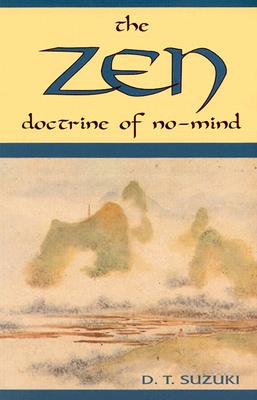
One of the greatest books ever written on the subject of Buddhism and, in particular, Zen is The Zen Doctrine of No-Mind written by the late Zen master Dr D T Suzuki (pictured left). I first read this book way back in 1973 when I was in my first year of Arts/Law at the University of Sydney. I have re-read the book many times since. It is not an easy book to understand. Indeed, it is a most difficult book to understand, even for those who know something about its subject-matter. (I'll come back to the interesting concept of 'no-mind' later in this blog.)

For this, my 100th, post, I thought I’d share with you some ideas and concepts which I have found, in my mindfulness practice, to be of assistance to me. I have, in many previous blogs, referred to these ideas and concepts, but it may be helpful to amplify them and try to bring them all together in this present blog.

Now, what are the characteristics of a ‘mindful mind’? In other words, what are the ‘conditions’ for a mind being ‘mindful’? What are the ‘things’ which permit appreciation, apprehension or recognition of a mind being ‘mindful’? (Note: These ‘things’ do not constitute ‘mindfulness’ per se. They are not the ‘conditions’ or ‘constituents’ of the state of being and 'living meditation' known as mindfulness.)

First, bare attention. Why ‘bare’? Well, we mean just enough attention to ‘wake up’ to the present moment, to ‘stay awake’ (and 'here and now'), and to observe what is taking place ... enough attention to be able to 'discern' without discriminating or judging. After all, there is a world of difference between being aware of a thought and thinking and analyzing that thought.

Bare attention is a mode of perception which, with passive detachment, perceives each moment exactly as it is as opposed to through some filter of one’s thoughts, ideas and feelings. (There is a saying in Zen [which, relevantly, means ‘exacting meditation’, by human effort, so as to reach beyond thought, indeed beyond verbal expression], 'Do not search for truth. Just stop having opinions.' Love it!)

Bare attention is a way of looking at experience, which adds nothing to, and takes nothing away, from the raw experience itself. There is no attempt to change things in any way. You interfere with nothing. Bare attention involves no comment, attitude, judgment or deliberation but simply sees and ‘notes’ what is ... without any attachment or identification (eg ‘There is anger in this body’ as opposed to ‘I am angry, and ‘There is thinking taking place’ as opposed to ‘I am thinking’). You are not your thoughts. Indeed, you are not even ‘the thinker’. In the words of Krishnamurti, attention 'frees the mind from habit.' He also said, 'Surely attention has no motive, no object, no toy, no struggle, no verbalization. This is true attention, is it not? Where there is attention, reality is.'

Second, choiceless awareness. Awareness is something you 'bring', effortlessly, and continuously, to each moment of the day. Awareness is also something 'in' which you 'live', in the sense of living in awareness of the present moment. We are talking about an awareness of all that the present moment 'contains' (thoughts, perceptions, assumptions, tendencies, memories, feelings, bodily sensations, sounds, etc).  

Now, one is ‘choicelessly’ aware when one is aware of whatever is ... when one objectively sees things-as-they-are ... things both inner and outer ... and without becoming attached to anything. Just as importantly, there is no choosing to be aware of one thing but not another.

In other words, there is no discriminating (that is, no decisions, no choices, no exercise of the will) ... and there are no demands ... not even preferences. One is simply ‘aware’ of whatever presents itself from one moment to the next as one’s experience ... that is, one simply looks, watches and observes ... without identifying oneself too closely with any elements (as per the above) of the experience ... and without judging anything that arises as 'good' or 'bad'. Thus, there is no 'I like this,' or 'I don't like that,' sort of thing.

That's right - there should be no analysis, comment, judgment, evaluation or condemnation ... and no 'abiding of thought' anywhere on anything ... just a constant, continuous, pliable, effortless and ever-present (and thus unconditioned) state of impartial, objective inquiry in which there is no 'conclusion'. Hence, there can be no room for 'beliefs' of any kind, for belief is just another form of conclusion. 

This is what Krishnamurti means when he says there needs to be observation 'without the observer' ... for where there is an 'observer' there is a conditioned mind and a conditioned point of view ... which is the past ... and where there is the past, there can be no mindfulness. Of course, in an empirical sense there will always be an observer, in the form of the 'person' that each one of us is, but that is about the extent of it.

The historical Buddha, Siddhartha Gautama, had much to say about meditation and mindfulness. One of his reported sayings is, "When the mind wanders, observe it as it is." What could be simpler than that?

There is a saying in Zen along these lines: ‘Using the mind to look for reality is delusion. Not using the mind to look for reality is awareness. Freeing oneself from the mind is total liberation.’ Get the picture?

Third, curiosity. A mindful mind is a curious and energetic mind ... not one which is dull or bored, but one which is living, moving and vital. It is a mind which is patient, flexible, open, even open-ended, receptive, and ever interested in whatever is the experience of the moment. Yes, an inquisitive (but non-clinging, indeed detached) mind, by means of which we become conscious of what was previously unconscious.

However, we must be careful not to allow our curiosity to deflect us from our ‘staying on track’. We all know what can happen when we follow a thought through to its supposedly logical conclusion. The result? 'Mental movies' complete with the 'latest sound system'. Ongoing internal dialogue. The ‘answer’? Stay fixed and focused, and fully present, in the finitude of the present moment ... without being rigid. That is why it helps to focus one’s attention on one’s breath. It takes the focus of attention away from one’s thinking and directs it into the body. That leads on to ...

Fourth, purposefulness. Mindfulness is paying attention ... in the present moment ... on purpose. That means that we consciously, deliberately and vigilantly direct and focus (not forcibly, but in a ‘soft focus’, gentle and kind sort of way) our attention and awareness to whatever be our experience from one moment to the next. Of course, mindfulness takes meditation and applies it to one’s entire life. Hence, Zen says, when you’re eating, just eat; when you’re walking, just walk; when you’re sitting, just sit, and so forth.

Fifth, spontaneity. A mindful mind is one which responds effortlessly, receptively and spontaneously ... without discrimination ... whilst resisting the temptation to repond unthinkingly.

Sixth, detachment. We 'feel' as if we were watching ourselves from the 'inside', so to speak. In other words, we are aware of what is happening from one moment to the next ... without 'feeling' involved in what is happening.

Now, let's look at the doctrine or concept of ‘no-mind’ (Jpn mushin).

A mindful mind is a mind of no-mind (Jpn mushin no shin). Yes, pure Zen, but it does make sense in a Zen sort of way. The doctrine or concept of ‘no-mind’ means no deliberate mind of one’s own. It does not mean the absence of mind, or absentmindedness, but rather a mind which is non-discriminating, uncoloured, fluid, unbound and free from deluded thought ... indeed, a mind where there is no conditioned thinking, desiring or controlling ... a spontaneous and detached state of mind characterised by inward silence and no knowing awareness ... a mind which effortlessly thinks what it thinks ... without there being any interference (judgment, analysis, etc) by some 'thinker' or 'ego' within the mind.

In order for a mind to be free from deluded thought it needs to be kept fully engaged in the present from moment to moment ... without there being any subjective evaluation or interpretation. Once we start evaluating and subjectively interpreting what is, we cease to experience life instantaneously and spontaneously. (Trying not to think, as opposed to forgetting to think altogether, is, of course, doomed to failure.) Alan Watts described 'no-mindedness' as a 'state of wholeness in which the mind functions freely and easily, without the sensation of a second mind or ego standing over it with a club'. Whatever comes up, moment by moment, is accepted without being embraced ... even non-acceptance.

So, a mind of no-mind is a mind which is unconscious of itself and empty of itself (yes, that supposed 'ego-self' which we mistakenly believe is us!) ... a mind which is ever imperturbable, that is, undisturbed by affects of any kind ... a mind which is effortlessly engaged in being here now ... a mind where there is no-effort and no-thought ... a mind which is present only to that which is happening now ... a mind which is, yes, ‘empty’ but whole (cf  the ensō [circle] pictured right) ... a mind which is 'nowhere in particular' (Takuan Sōhō).

Wow! A state of ‘no-mind-ness’ or ‘no-mindedness’ ... characterised by effortlessness and a constant non-discriminating yet gentle-on-oneself 'unbinding' of the mind and letting go of all mental effluents and other ‘traffic’.

You are ‘no-minded’ when you let life live out its self-livingness in and as you ... and as all other things and persons. You are 'no-minded' when you let go of all self-identification, self-absorption, self-obsession and self-centredness. You are 'no-minded' when you let go of all attachments, presuppositions, assumptions and stories ... when you leave the mind empty of all greed, anger and delusion (ignorance).

Most of us engage in compulsive, and generally useless, thinking. We never stop thinking. Indeed, we find that our minds take up all of our attention! We identify ourselves with our minds, and so find ourselves trapped in time, ‘living’ (if you can call it that) exclusively through memory, evaluation, interpretation, judgment, analysis, and anticipation ... anything but actually living purposefully and consciously from one moment to the next. Our minds have become so conditioned that they are very good at denying, and seeking to escape from, the present moment ... which is the only moment we have. Remember the immortal words of Omar Khayyám? ‘Be happy for this moment. This moment is your life.’

So, dear friends, let us cultivate an ‘empty’ mind ... a mind of no-mind ... empty, but also full and luminous! It is said in Zen, ‘Know that only the empty mind can see the Buddha.’ If you are not a Buddhist, you can easily rephrase that to, ‘Know that only the empty mind can see Reality ... know Truth ... and experience Life as it really is.’ Same thing.


(This blog sets out a simple form of mindfulness sitting meditation.)


RELATED POSTS